A pack of 12 giant dog sculptures has taken over Central Park
French artist Camille Henrot just debuted 'Dogs,' a free public art installation featuring a dozen large-scale canine sculptures.
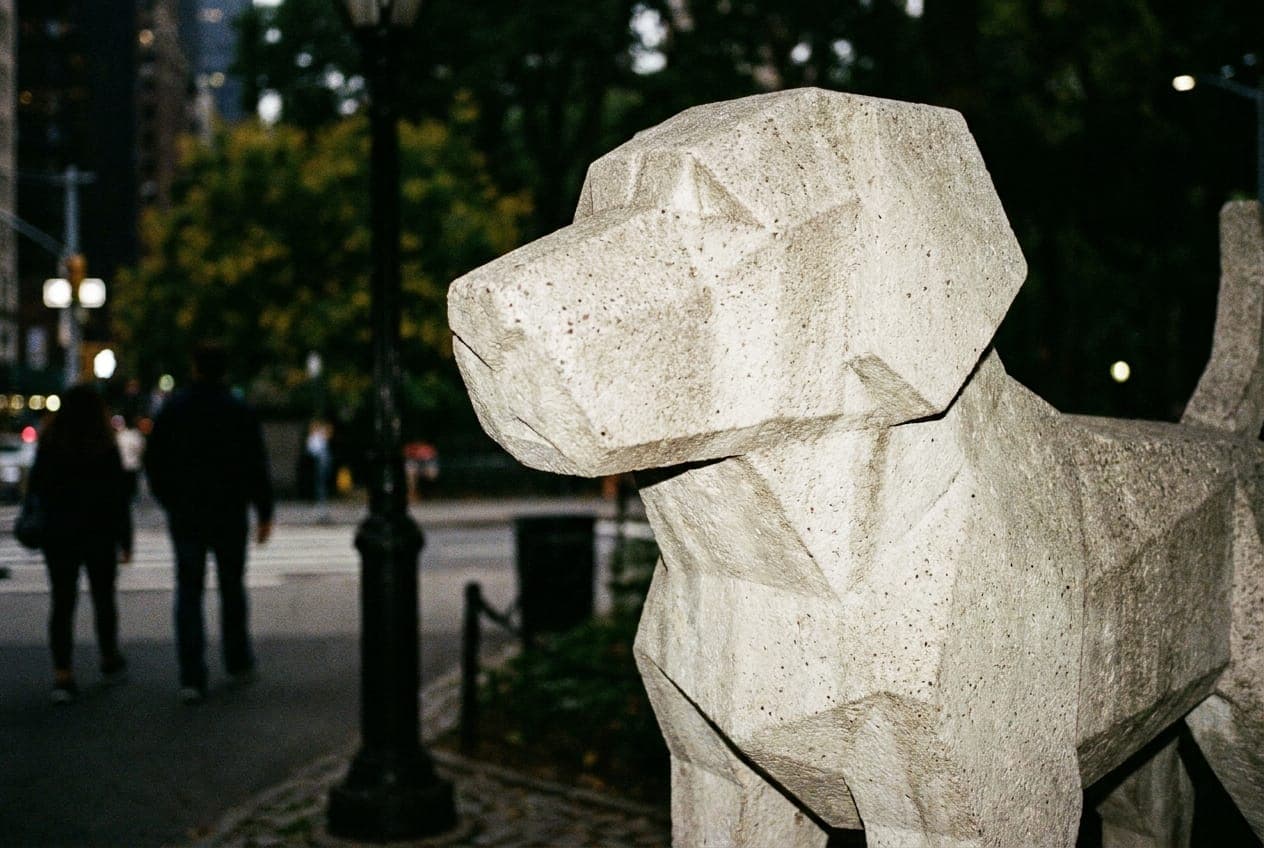
New Yorkers treat dog ownership as a highly visible, deeply serious lifestyle. We dress them in cashmere sweaters, we push them in specialized strollers down Fifth Avenue, and we aggressively negotiate for bench space at the local runs. We know the neighborhood walkers who wrestle six tangled leashes at a time, and we know exactly which sidewalk corners to avoid on a rainy morning. Now, a much quieter, slightly stranger pack has claimed territory right at the edge of Central Park. French contemporary artist Camille Henrot just debuted "Dogs," her first public exhibition in the city, transforming the Doris C. Freedman Plaza into a surreal canine show with 12 large-scale sculptures.
If you are accustomed to seeing standard bronze statues of generals on horseback or stoic political figures scattered around Manhattan, Henrot provides a weird, welcome visual relief. This is not a formal monument to a forgotten war. It is a strange, playful, and deeply observant commentary on the animals we invite into our homes. Commissioned by the Public Art Fund, the installation features a dozen mixed-media dogs cast in bronze, stone, steel, and concrete. They are built to withstand the elements, the sudden autumn downpours, the winter snowdrifts, and whatever stray hands touch them over the next year.
The artistic pedigree
Henrot, who was born in Paris but lives and works in New York, has spent years exploring the invisible codes that bind our lives. She works across film, drawing, and painting, but her sculptural work often zeroes in on how we structure our habits and our relationships. With this installation, she is directly tackling the concepts of attachment, delegated care, and domestication. By choosing dogs as her subject, she taps into an animal that is deeply social, completely dependent on human intervention, and historically molded by our own shifting preferences.
The aesthetic of these 12 sculptures does not try to be strictly realistic. Instead, Henrot pulls her visual references from an incredibly wide net. You will see shapes that echo the stiff, reverent geometry of ancient Egyptian sculpture right next to the exaggerated, elastic proportions of old Tex Avery cartoons. She also draws heavily from the sharp, economic line work of Saul Steinberg drawings and the highly codified, often absurd rules of modern dog show competitions.
The materials themselves reflect the diversity of the pack. One piece features a heavy white dog constructed from concrete and epoxy, carrying a book balanced on its back. Another sculpture presents the negative image of a dog, precisely cut out of a sheer sheet of steel so that the city behind it becomes part of the animal. There are heavy bronze cast pieces and solid stone forms, creating a group that feels less like a uniform breed and more like the chaotic mix of mutts and purebreds you see waiting outside a corner bodega on a Saturday morning.
By placing these stylized, dependent creatures right where the grid of Manhattan meets the wilder, landscaped paths of the park, Henrot forces us to look at our own habits of care and control. Dogs in New York City are an extension of our own personalities. We project our anxieties and our styles onto them. Henrot understands this, and her steel and concrete pack acts as a mirror to the parade of actual dogs that pass by the plaza every single day.
A plaza built for interruption
The Doris C. Freedman Plaza has a long history of hosting ambitious public works. Named after the founder of the Public Art Fund, this stretch of pavement has served as an open-air gallery for decades. Freedman was an essential force in the 1970s art world, fighting for artists' rights to live and work in SoHo lofts and pushing the radical idea that contemporary art should not be locked behind museum admission fees. Her legacy is the reason we get to stumble upon massive installations on our commute.
Henrot's exhibition feels like a perfect continuation of that ethos. It is accessible, it is impossible to ignore, and it sparks conversation between total strangers. You do not need an art history degree to have an opinion on a giant concrete terrier with a book on its back. It levels the playing field. New York can often feel closed off, full of private members clubs and exclusive guest lists, but the plaza remains stubbornly open. When the Public Art Fund installs a piece like this, they are actively changing the emotional temperature of the neighborhood for a full year.
The dog show parallel
Henrot's deliberate nod to dog show culture is particularly resonant in Manhattan. The Westminster Kennel Club Dog Show is a local institution, and the meticulous grooming, the strict posture requirements, and the sheer human effort required to make a dog stand perfectly still are all echoed in these sculptures. Henrot captures that tension between wild animal instinct and intense human training. The rigid posture of her bronze pieces mirrors a show dog stacked for the judges, holding its breath while a handler adjusts its tail.
But outside of Madison Square Garden, everyday life with a dog in New York is its own kind of show. Every walk is a public performance. You are constantly managing interactions, apologizing for barking, and navigating the crowded sidewalks. Henrot's sculptures freeze those moments of tension and comedy into permanent monuments. The negative space steel cutout literally frames the city, capturing yellow cabs and passing pedestrians inside the silhouette of a dog. It is a visual trick that reminds us how deeply our pets are integrated into the chaotic background noise of New York.
Where to find the pack
The installation takes over the Doris C. Freedman Plaza, located at the southeast entrance to Central Park right at 59th Street and 5th Avenue. This specific corner is one of the busiest thresholds in the city. You have the horse-drawn carriages lining up along Central Park South, the tourists streaming out of the Apple Store, and the looming facade of the Plaza Hotel watching over the intersection. Injecting 12 giant, cartoonish dog sculptures into this mix grounds the space in something deliberately absurd.
You do not need a ticket, and there are no restrictive hours to worry about. The plaza is entirely free and open to the public from dawn to dusk. The dogs will hold their ground here through August 29, 2027, meaning you have plenty of time to see how their metallic and stone surfaces look against the changing seasons. If you are keeping track of public art in New York, this is a massive addition to the landscape. It is the kind of exhibition you can visit for five minutes on your way to work, or study for an hour on a lazy weekend.
How to make an afternoon of it
Because the plaza sits right at the mouth of the park, you can easily fold the exhibition into a larger weekend plan. We suggest starting your morning on the Upper East Side. Grab a strong cortado from one of the best coffee shops in New York City nearby, walk the perimeter of the plaza, and debate which sculpture looks the most like your own pet or your neighbor's notoriously loud terrier.
From the 59th Street entrance, you can wander straight into Central Park for a proper autumn walk. If you are crossing off your Fall 2026 New York Bucket List, mapping a route from the dog sculptures past the Pond, up over the Gapstow Bridge, and through the Mall toward Bethesda Terrace is about as classic as it gets. The canopy of the trees turning yellow and orange in late October is the ideal visual chaser to Henrot's industrial materials.
You can also head north up Fifth Avenue toward the museum mile to catch more of the fall museum and gallery shows opening this season. The transition from massive public bronze outside to quiet, climate-controlled galleries inside makes for a perfectly balanced New York day. Just remember that while you can bring your actual dog to sniff the metal ones, they belong in one of the actual dog parks and runs if they need to burn off energy. The Doris C. Freedman Plaza is a place for observation, not a bathroom break.
The Shout NY take
Public art is best when it interrupts your daily routine with something slightly out of place. Henrot has managed to take the very serious medium of heavy cast sculpture and turn it into a playful reflection on city life. The dogs do not demand quiet reverence. They are funny, they are odd, and they are deeply relatable to anyone who has ever compromised their entire schedule to accommodate an animal. Go on a weekday morning when the harsh autumn light hits the plaza, and watch actual dog walkers pause to let their pets investigate the new metal competition.
Shop the story.
- 01Amazon ↗
Public Art Fund: A History of Bold Initiatives
Learn more about the organization that commissioned this thought-provoking exhibition.
- 02Amazon ↗
The Art of Saul Steinberg
Discover the distinctive line work that influenced the aesthetic of the dog sculptures.
- 03Amazon ↗
Westminster Kennel Club Dog Show: A History
Delve into the dog show culture that inspired elements of Henrot's sculptures.
- 04Amazon ↗
Central Park Conservancy Official Guide
Navigate the park to find the 'Dogs' installation and explore other landmarks.
Make a trip of it.
Vrbo homes and apartments in Midtown, searched for the coming weekend.
Questions, answered.
- Where are the Camille Henrot dog sculptures in Central Park?
- The sculptures are located at the Doris C. Freedman Plaza, right at the southeast entrance to Central Park on 59th Street and 5th Avenue.
- How long is the Camille Henrot 'Dogs' exhibition on view?
- The installation is on view through August 29, 2027, and is completely free to visit from dawn to dusk.
- What materials are the dog sculptures made of?
- The 12 large-scale dogs are cast in a mix of outdoor-friendly materials, including bronze, stone, steel and concrete.
Get the Shout Sheet.
One email every Thursday with what to do in New York this weekend. Free.