Is This Still It? The rooms that made New York rock again, and the ones you can still walk into
Between 1999 and 2005 a few hundred people in a handful of small clubs changed what guitar music sounded like. Most of the rooms are gone. Some are not.
Every city has a scene it romanticizes. New York has several, and the most recent one to earn the full mythology is the rush of guitar bands that came out of the Lower East Side and Williamsburg around the turn of the century. You know the names: The Strokes, Yeah Yeah Yeahs, Interpol, LCD Soundsystem, TV on the Radio. The records were great. But the thing worth remembering is how small it all was. This was a scene that happened in rooms that held 150 to 250 people, most of them within a ten-minute walk of each other.
That is why it is worth revisiting now, with some of those rooms still open and one of the most important ones counting down its final months. The bands became famous. The rooms mostly did not survive. What follows is a short history, drawn from the public record and from Lizzy Goodman's oral history Meet Me in the Bathroom, and a practical guide to the ones you can still walk into.
The map was tiny
In 1999 the Lower East Side was cheap, a little scary and full of bars with back rooms. Ludlow Street had Luna Lounge at number 171, opened in 1995, which did something unthinkable by modern standards: live music was always free. When it closed, it was described as the last spot in the neighborhood with nightly rock shows and no cover. On Monday nights it hosted a comedy series called Eating It, which put Sarah Silverman, Janeane Garofalo and Louis C.K. on the same stage bands used the rest of the week.
Around the corner on Houston Street was Mercury Lounge, opened in 1993 by Michael Swier, Michael Winsch and Brian Swier in a building that had been a tombstone retailer for sixty years. A few blocks east on Avenue A was the HiFi Bar, which had spent thirteen years as the rock club Brownies before changing names in 2002. In 1998 the Mercury team opened Bowery Ballroom on Delancey Street in a 1929 building originally meant to be a high-end haberdashery, and gave the neighborhood a room that held 575 with the best sightlines in the city.
Those were the stations of the cross. A band could play Luna for free, graduate to Mercury, and headline Bowery if things went right. For a few years, that ladder worked unusually fast.
The Strokes and the booker who quit
The Strokes formed in 1998. Julian Casablancas, Nick Valensi and Fabrizio Moretti had met as teenagers at the Dwight School in Manhattan, and they added Nikolai Fraiture and Albert Hammond Jr. Their first show as The Strokes was on September 14, 1999, at a small club called The Spiral. From there they worked the circuit: HiFi Bar, Luna Lounge, Mercury Lounge.
The detail that tells you how close-knit this world was: Ryan Gentles was booking Mercury Lounge when he saw the band, and he quit the job to manage them. In 2000 they recorded with producer Gordon Raphael, and in 2001 the British label Rough Trade released The Modern Age EP, which set off what was reported as the biggest label bidding war for a rock band in years.
Is This It came out in Australia in July 2001 and in the UK in August. The American release on RCA did not arrive until October, delayed in part by concern over the cover art and the song "New York City Cops" in the weeks after September 11. The record made a scene that was a few blocks wide suddenly international.
Yeah Yeah Yeahs and the White Stripes night
Karen O, Nick Zinner and Brian Chase came together in 2000, and their origin story also runs through Mercury Lounge: Karen O recruited Chase as drummer right before the band opened for The White Stripes at the club in September 2000. Their self-titled debut EP came out in July 2001 on their own label. When Albert Hammond Jr. wore a Yeah Yeah Yeahs pin during a Strokes appearance on Saturday Night Live, the EP got reissued by bigger labels, and the band crossed the river into Williamsburg's new rooms and then to the world.
Fever to Tell arrived in May 2003 and sold over a million copies worldwide, powered by a ballad that became their signature. Two decades later the band is still working: they signed with Secretly Canadian, released Cool It Down in 2022, and in 2025 toured intimate theaters on the Hidden in Pieces Tour.
Interpol and the NYU philosophy class
Interpol formed in 1997 when guitarist Daniel Kessler met drummer Greg Drudy, then recruited bassist Carlos Dengler, whom Kessler met in a philosophy class at New York University, and singer Paul Banks. They played early shows at Luna Lounge on the same circuit as The Strokes and The National.
Turn On the Bright Lights came out on Matador on August 19, 2002, and Pitchfork named it the best album of the year. Where The Strokes sounded like a sunny late afternoon on Avenue A, Interpol sounded like walking home at 4am in a good coat. In June 2026 the band announced its eighth album, This Mirror Weighs a Ton, its first for Partisan Records.
Across the river: Northsix and the Williamsburg turn
By 2001 the rents on the Lower East Side were rising and the bands were living in Williamsburg. The venues followed. Union Pool opened in 2000 on Union Avenue in a former pest control and swimming pool supply store. In spring 2001 Northsix opened at 66 North Sixth Street, one of the first of a wave of Brooklyn music venues. The Village Voice named it best new rock club in 2002. In 2003 it appeared as a location in Richard Linklater's School of Rock, and that same year Elliott Smith played a three-night stand there that turned out to be his final New York shows.
Northsix was also the kind of place where the downtown bands and the stranger Brooklyn acts shared bills. TV on the Radio, founded in Brooklyn in 2001 by Tunde Adebimpe and Dave Sitek, came out of that world, releasing the Young Liars EP in 2003 and Desperate Youth, Blood Thirsty Babes in 2004. In 2007, facing a rent increase, Northsix was taken over by The Bowery Presents, renovated and renamed Music Hall of Williamsburg.
The dance floor: DFA and LCD Soundsystem
The other half of the story happened on dance floors. In 2001 James Murphy, Tim Goldsworthy and manager Jonathan Galkin founded DFA Records, which began with 12-inch singles, starting with The Rapture's "House of Jealous Lovers." In 2002 Murphy released "Losing My Edge" as LCD Soundsystem, a very funny, very sad song about being an aging hipster in a scene full of younger ones. It became a kind of anthem for people who had been at all the right shows.
LCD's debut album came out in January 2005 and earned a Grammy nomination. The band announced its breakup in 2011 and played a farewell at Madison Square Garden on April 2, 2011, documented in the film Shut Up and Play the Hits. Then they came back, headlining Coachella in 2016, releasing American Dream in 2017, and since 2021 settling into long residencies at Brooklyn Steel, which has become their home room.
The closings
The scene's rooms went the way New York rooms go. Luna Lounge closed in June 2005, after the landlord sold the one-story building to a buyer who planned to demolish it, and it was torn down that July. Owner Robert Sacher opened a second Luna Lounge in Williamsburg in January 2007; it closed in April 2008, and the space became the Knitting Factory Brooklyn, which closed in 2022.
The HiFi Bar served its last drinks on October 29, 2017. Rothko, a small Lower East Side club that opened in 2004 and booked shows by The Killers and LCD Soundsystem, closed in 2006. Plant Bar on East 10th Street closed in 2009. Don Hill's closed in 2011. In Williamsburg, Galapagos Art Space moved to Dumbo in 2007, and Death by Audio played its final show on November 22, 2014, after Vice Media took over its building.
And the room where half this story took place is next. In December 2025, Music Hall of Williamsburg announced it expects to close at the end of 2026 after the owners of 66 North Sixth Street declined to renew its lease.
The rooms you can still go to
Here is the good news. Several of the places that made this era are still open, still booking, and still worth your money.
Mercury Lounge
Lower East Side · 217 E Houston St
Still about 250 capacity, still one of the best-sounding small rooms in the country, still where bands try to get booked first. Since 2017 its shows have been promoted under Mercury East Presents, a partnership with Live Nation, but the room itself feels like it always has. Stand at the back bar and imagine a booker quitting to manage a band.
Bowery Ballroom
Lower East Side · 6 Delancey St
Opened in 1998 and unchanged in the ways that matter: a downstairs bar, a balcony, great sound and 575 capacity. It is still where a band on the rise plays the show that proves it.
Pianos
Lower East Side · 158 Ludlow St
Opened in 2002 in a former piano store, just up the block from where Luna Lounge used to be, and kept the old sign. With two small stages and cheap weeknight bills, it is the closest thing left on Ludlow to the free-show spirit of the old days.
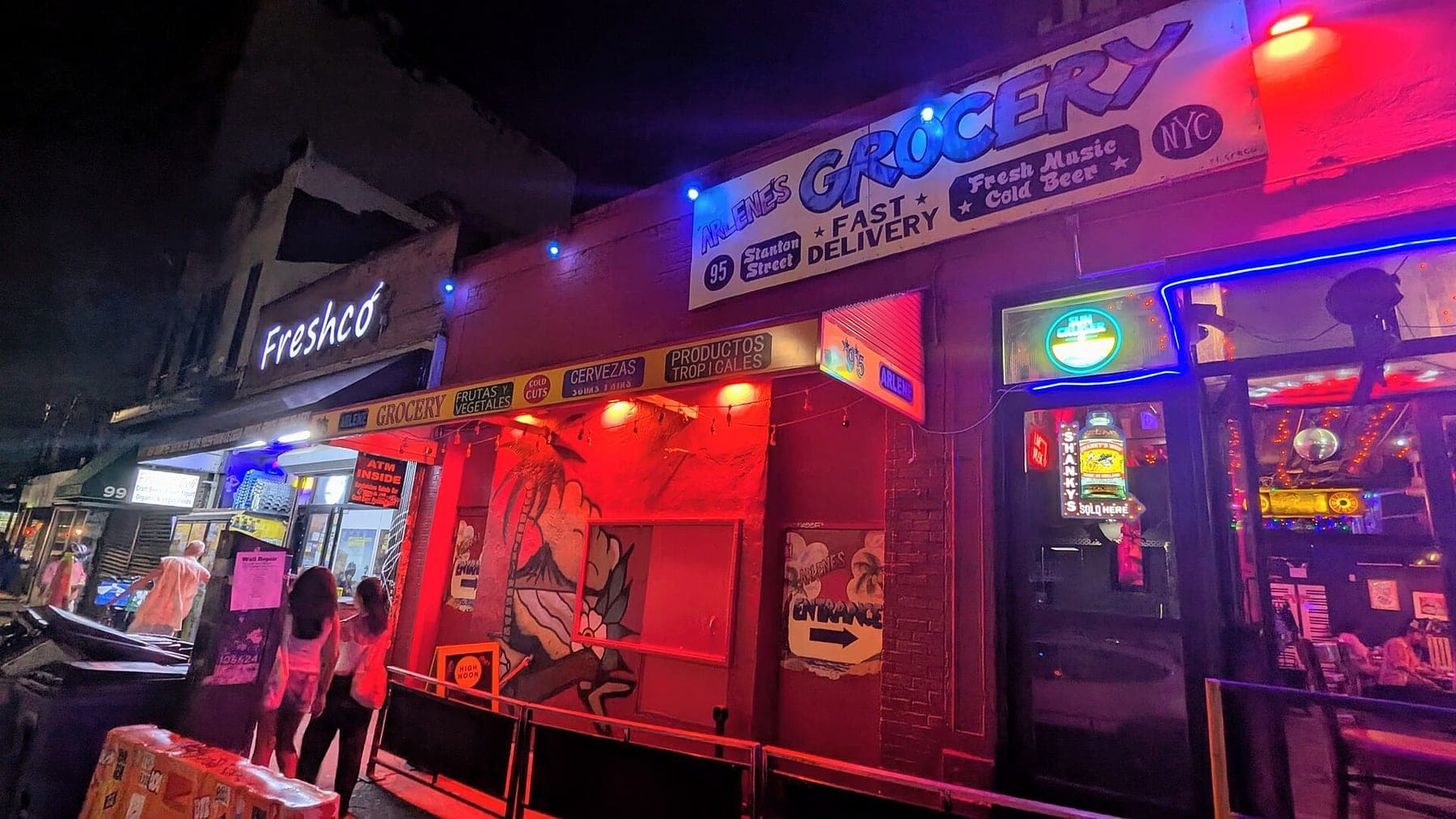
Arlene's Grocery
Lower East Side · 95 Stanton St
A Lower East Side rock club since 1995 and still going, now best known for its rock-and-roll karaoke nights, where you sing with a live band. It is an extremely good way to find out if you could have been in The Strokes.
Union Pool
Williamsburg · 484 Union Ave
Open since 2000 and still one of Brooklyn's great bars, with a back room for about 150, a patio and DJs until 4am. It is the Williamsburg link that never broke.
Music Hall of Williamsburg
Williamsburg · 66 N 6th St
The former Northsix is open through the end of 2026. Go see something here this fall. You will be standing in the room where the Brooklyn chapter of this story got written.
Enid's
Greenpoint · 560 Manhattan Ave
Not a venue, but a long-running Greenpoint bar and restaurant that is still open, and still the kind of place where a band gets a drink after a show.
What it means now
It is tempting to say nothing like it could happen again. That is what people always say, and they are usually wrong. The conditions that made the early 2000s possible were cheap rent, small rooms with bookers who took chances, and a few blocks where everyone ran into everyone. The rent is not cheap anymore. The small rooms and the bookers are still here, though now they are mostly in Bushwick and Ridgewood.
So read Meet Me in the Bathroom, watch the documentary, and then do the thing the book is actually about. Buy a ticket for a band nobody has heard of at a room that holds 250 people. Our small venue guide and our list of new New York acts to see this fall are good places to start. The next scene is already playing. It just has not been named yet.
Questions, answered.
- Where did The Strokes play their first show?
- The Strokes played their first show under that name on September 14, 1999, at a small Lower East Side club called The Spiral. They built their following at Manhattan rooms including the HiFi Bar, Luna Lounge and Mercury Lounge.
- What is Meet Me in the Bathroom about?
- Meet Me in the Bathroom is Lizzy Goodman's 2017 oral history of the New York rock scene from roughly 2001 to 2011, covering The Strokes, Yeah Yeah Yeahs, Interpol, LCD Soundsystem and their circle. A documentary adaptation by Will Lovelace and Dylan Southern premiered at Sundance in January 2022.
- Is the Mercury Lounge still open?
- Yes. Mercury Lounge at 217 East Houston Street opened in 1993 and is still booking shows in 2026, with a capacity of about 250. Bowery Ballroom, its larger sister club at 6 Delancey Street, is also open.
- What happened to Luna Lounge?
- Luna Lounge at 171 Ludlow Street closed in June 2005 and the building was demolished that summer. A second Luna Lounge opened in Williamsburg in 2007 and closed in 2008; that space later became the Knitting Factory Brooklyn, which itself closed in 2022.
- Is Music Hall of Williamsburg closing?
- Yes. The venue, which opened as Northsix in 2001 and was renamed in 2007, announced in December 2025 that it expects to close at the end of 2026 because the building owners declined to renew its lease.
Get the Shout Sheet.
One email every Thursday with what to do in New York this weekend. Free.